DATA by the Zimbabwe Peace Project (ZPP) on human rights violations collected between January and September has shown that the country’s human rights situation presents a picture of consistently high repression, marked by significant regional disparities and a concerning late-year surge.
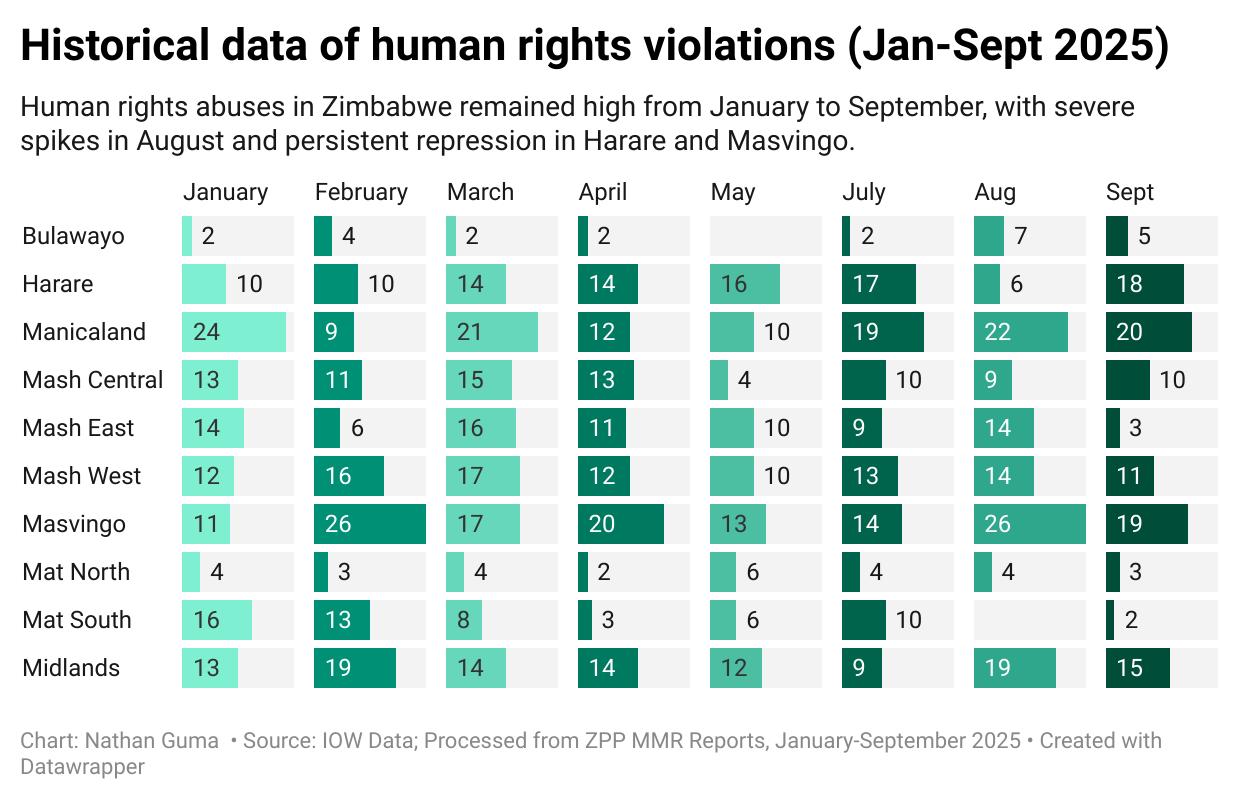
The capital, Harare, and the province of Masvingo have been persistent hotspots throughout the nine-month period.
Harare maintained a consistently high level of violations, frequently recording figures in the mid-teens, culminating in an 18-case peak in September, while Masvingo experienced extreme volatility, with severe spikes reaching 26 cases in both February and August, indicating repeated crises.
In contrast, the Matabeleland regions, particularly the North, reported consistently lower figures, suggesting a geographical imbalance in the application of state repression.
However, this relative calm was shattered in August, which emerged as a particularly brutal month nationally.
Alongside the peak in Masvingo, provinces including Midlands, Manicaland, and even typically quieter areas like Bulawayo saw significant surges.
This data reveals a two-tiered reality: a constant, high level of abuse in certain regions, superimposed with a nationwide escalation in August that signals a sharp and coordinated deterioration in the human rights landscape as the year progressed.
Data for September shows that human rights violations across were fueled by systemic political coercion and the weaponisation of state resources, which has also been a consistent marker.
The highest concentration of abuses was recorded in Manicaland, which led all provinces with 20 documented violations.
This was closely followed by Masvingo (19 violations) and Harare (18 violations). The lowest number of incidents was registered in Matabeleland South, which recorded just two violations. IOW Data.