BY PANASHE BOTA
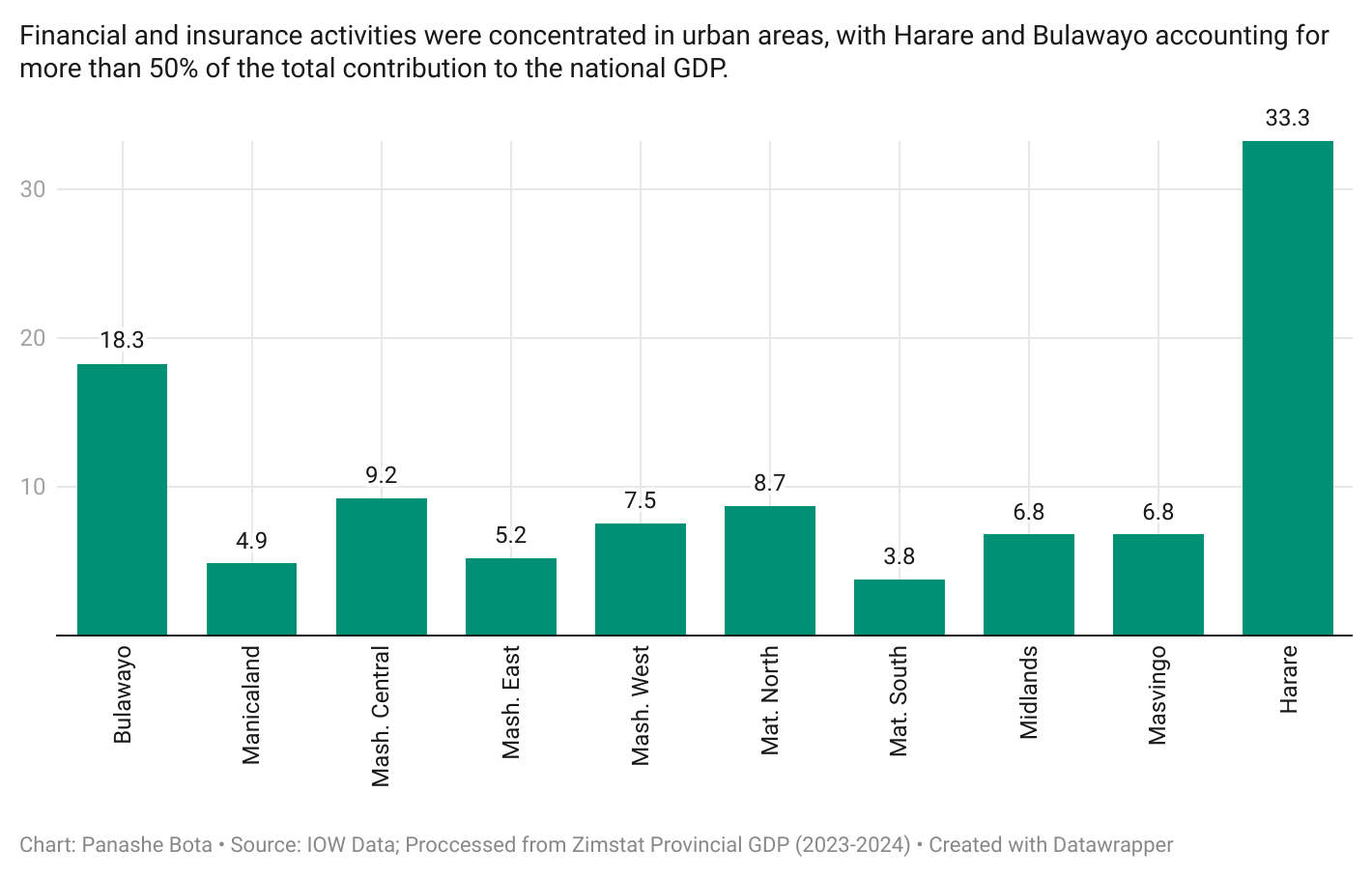
NEW data has shown that financial and insurance services are concentrated in urban areas, with Harare and Bulawayo, Zimbabwe’s capital and second-largest cities, accounting for more than 50% of the total contribution to the national GDP.
According to the Zimbabwe National Statistics Agency (Zimstat) data on Financial and Insurance Activities, Harare contributed 33.25% and Bulawayo 18.27%, giving a total combined contribution of 51.52% to the industry.
The combined share indicates a centralisation of financial capital and infrastructure in the two cities.
While the financial and insurance activities sector contributed 10.96% to the total national GDP in 2024, its share declines outside the main urban centres.
For instance, Matabeleland South accounted for 3.76% of the national total in 2024, while Manicaland contributed 4.87%.
Analysis of constant price growth rates for 2024 shows continued, though moderate, expansion in these centres.
Bulawayo recorded a financial and insurance activities GDP growth rate of 1.82%, slightly higher than Harare’s 1.65%.
Despite this, the concentration in Harare and Bulawayo reflects continued spatial inequality in access to and contribution from financial services across the country.
According to data aggregation organisation Statista, Zimbabwe’s insurance market has been projected to reach a market size (gross written premium) of US$2.54bn this year.
Within the market, Non-Life Insurances dominate with a projected market volume of US$1.48bn, while the average spending per capita is estimated at US$146.43. – IOW Data.