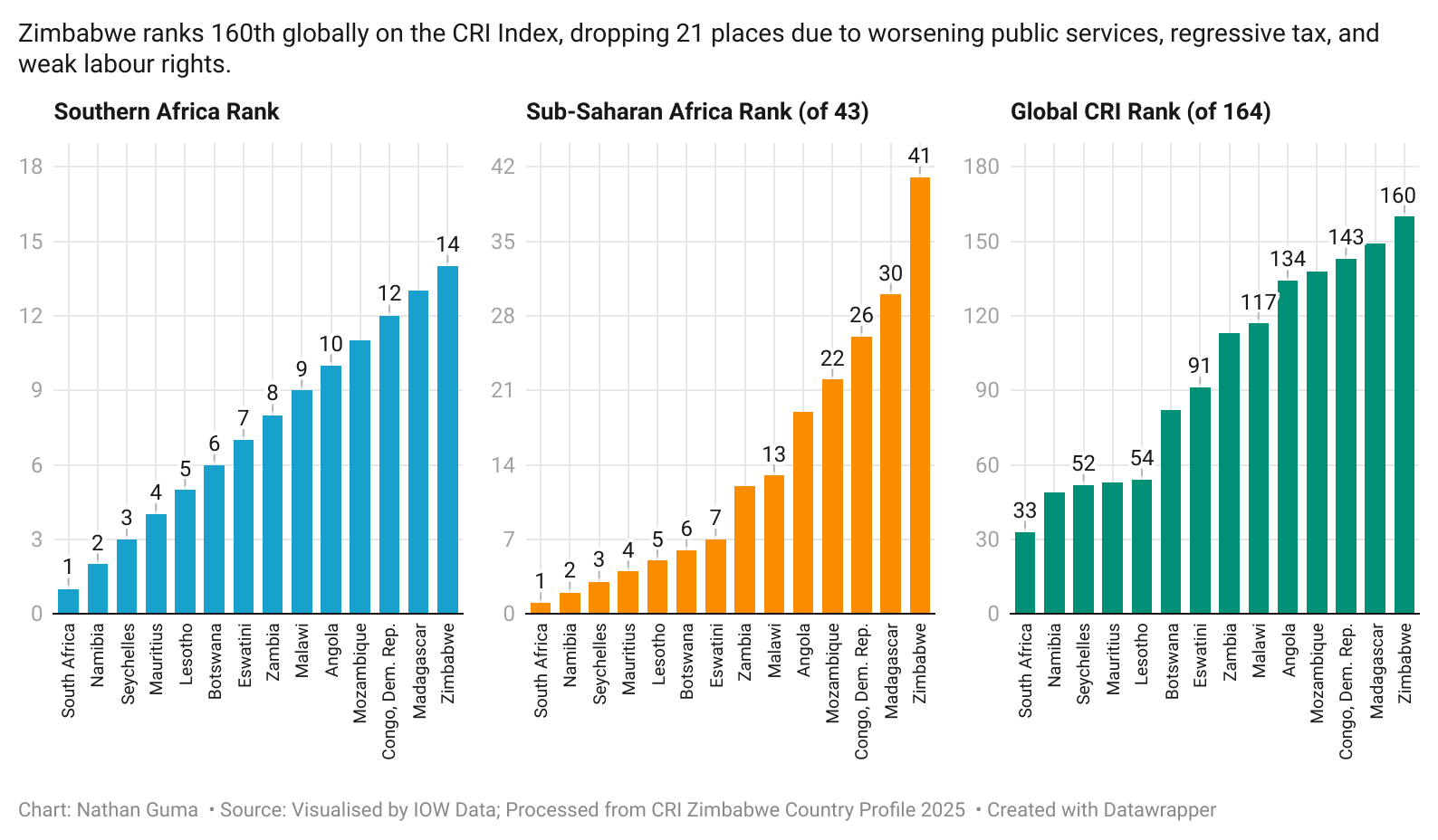
ZIMBABWE has recorded one of the steepest declines in the global 2025 Commitment to Reducing Inequality (CRI) Index, falling 21 places to 160th out of 164 countries, indicating how the country’s policies and actions to reduce inequality have worsened relative to other countries between 2022 and 2024.
The CRI, compiled by Development Finance International and Oxfam, assesses government policies to reduce inequality across three pillars – public services, progressive taxation, and labour rights.
Zimbabwe’s performance on the Public Services Pillar has been weak, ranking 10th out of 14 countries in Southern Africa and 125th globally.
According to the index, income and wealth inequality in Zimbabwe have escalated sharply, reaching extreme levels.
The top 10% of earners receive 52% of the national income, while the bottom 50% earn just 12%.
Wealth disparities are even more severe: nearly one-third of all wealth is held by the top 1%, 56% by the top 10%, while the bottom half holds only 3%.
“In Zimbabwe, inequality has prevented the benefits of growth from reaching the poorest, leaving poverty persistently high,” the report notes. “Following a series of economic and climate shocks, extreme poverty surged to nearly 49% of the population in 2020.”
Although data show that conditions improved slightly by late 2021, extreme poverty still affected 43% of the population. By 2024, this had fallen marginally, but an estimated 38% of Zimbabweans still lived in extreme poverty – a reversal from the earlier declines recorded in the 2010s, according to the CRI.
Public Services Pillar
Data show that Zimbabwe has been trailing its regional neighbours in the public services pillar, ranking 10th out of 14 countries, despite being in the top third of sub-Saharan African nations.
“It performs relatively poorly (in the bottom third) worldwide,” reads the CRI. “This weak performance is largely due to very limited access to public services, declining spending levels, and the increasingly limited impact of public services on inequality.”
Education
Inequality persists in education, with Zimbabwe allocating 17% of its national budget to the sector, below the 20% benchmark set by both the Dakar Framework for Action and the SDG 4 Education 2030 Framework.
“According to the completion indicator, just 1% of children from the poorest income quintile complete secondary education – a stark indicator of educational inequality.”
Health
Public health spending in Zimbabwe remains low, at just 10% of the national budget.
“While this places the country mid-range among Southern African nations, it remains well below the African Union’s Abuja Declaration target of 15%,” the CRI states.
“The consequences of under-investment are severe, with one in every ten households facing catastrophic out-of-pocket health spending, pushing many into poverty and deepening inequality.”
Social Protection
Zimbabwe has been allocating meagre resources to social protection, spending just 6% of total government expenditure.
Coverage remains low and uneven, with only around 20% of older people covered, mainly through contributory pensions that benefit wealthier groups.
“Overall, social protection benefits reach just 16% of those who qualify, and alarmingly, only 2% of people identified as vulnerable receive any support – a proportion that has declined in recent years,” the report says.
“Due to this limited reach and inadequate targeting, the social protection system fails to meaningfully reduce poverty and inequality.” – IOW Data.