

NEW data from Access Now shows signs of waning democracy and freedom of expression, with indications that internet shutdowns have been on the rise over the past decades.
This comes at a time when freedom of expression is now severely under attack in several countries.
For instance, on 29 October 2025, Tanzania went offline after a nationwide internet shutdown on election day cut digital communication across the country, renewing concerns about transparency and civic participation.
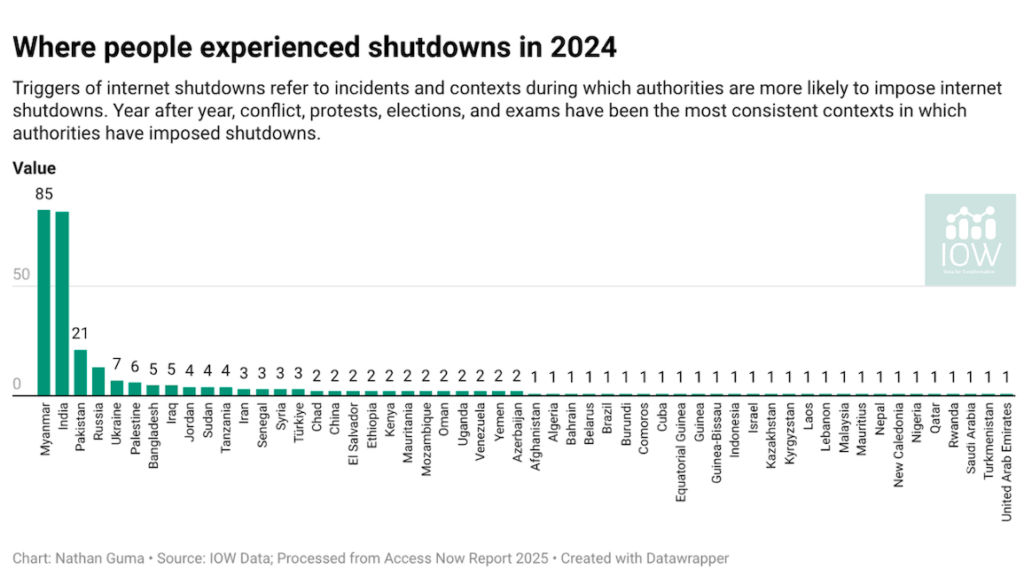
In January during general elections, Uganda was also cut-off from the internet by its government, alleging that internet cables had been disturbed by a make shark in the Indian Ocean.
Data by Access Now shows that in 2024 alone, Africa recorded 21 internet shutdowns across 15 countries, often coinciding with elections, protests, or periods of political unrest.
Read also: Data: Annual number of children newly infected with HIV (1990-2024)
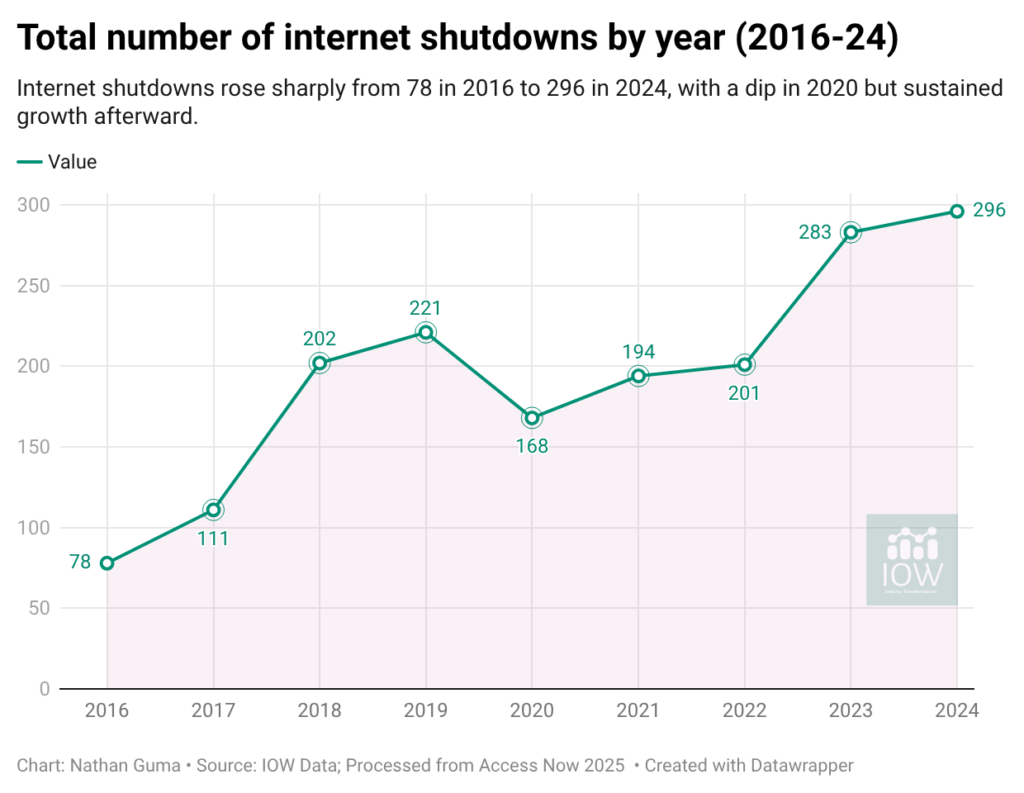
Globally, the same year marked a record high of 296 shutdowns in 54 countries, signalling that digital disconnection is becoming a normalised tool of state control rather than an emergency measure.
Since 2016, more than 1,700 internet shutdowns have been documented worldwide, with Africa featuring prominently.
Ethiopia has been among the continent’s most frequent users of shutdowns, recording around 30 between 2016 and 2024, particularly during conflict in Tigray and Oromia.
Sudan and parts of eastern Democratic Republic of the Congo have also experienced repeated disruptions linked to violence and political instability. In February 2024, Senegal cut internet access amid election protests, silencing millions.
The economic consequences are significant.
In 2022, internet shutdowns cost the world nearly US$25 billion, with low- and middle-income countries bearing the heaviest losses.
In 2024, sub-Saharan Africa alone lost more than US$1.6 billion due to shutdowns, with the losses especially damaging in a region where mobile money, digital trade, and online services underpin much of the informal economy.
Beyond economics, shutdowns have been deepening digital inequality, with rural communities, refugees, and women disproportionately affected as they rely heavily on mobile connectivity for livelihoods, education, and safety.
Despite this, governments have continued to justify shutdowns in the name of national security, even as they promote digital economies. – IOW Data.

