BY OWEN GAGARE
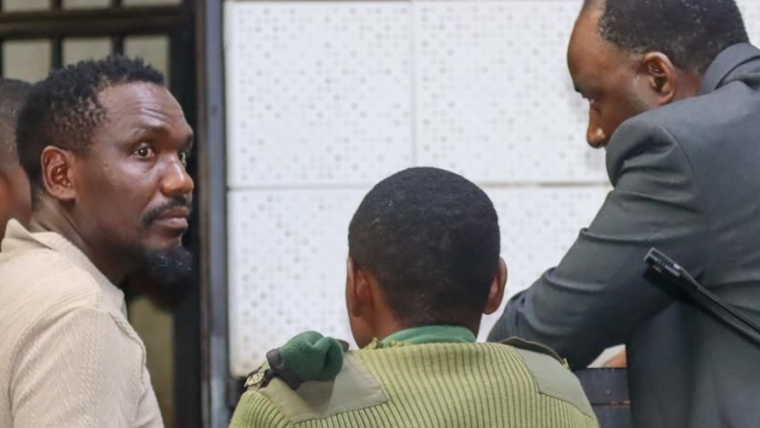
JOURNALIST Blessed Mhlanga (pictured) knew he was in for a tough time when he was arrested on 24 February, 2025 and later charged with transmitting information that incites violence or causes damage to property under Section 164 of Zimbabwe’s Criminal Law (Codification and Reform) Act, but he had no idea of the scale of problems that awaited him.
Mhlanga was detained at the old and dilapidated Harare Remand Prison as he answered charges emanating from interviews he did in November 2024 and February 2025 with the late outspoken war veteran Blessed Geza. Geza, a former Zanu PF central committee member, demanded the resignation of President Emmerson Mnangagwa, whom he accused of nepotism, corruption and incompetence.
The lice-infested and over-crowded Harare Remand Prison was his home for 72 harsh days, which he says will remain etched on his memory forever.
He, like all other inmates at the 116-year-old prison, slept on a hard concrete floor in a crowded cell, throughout his detention.
“I was in B1 holding cell, which was built to accommodate 40 inmates. For the three months that I was in Harare Remand Prison, the least number of inmates that was there was 80. But at times we had 120 to 130 people in the cell,” he said.
“So, what you basically had were people sleeping in overcrowded conditions to the extent that there was no freedom to turn around or stretch. It is an extreme sport to be able to have sleep whilst in Harare Remand Prison.”
Mhlanga said the cell was so overcrowded that some inmates known as a “cell staff”, are given the duty of arranging sleeping positions to ensure everyone fits. The cell staff are inmates selected by prison guards, to ensure there is order in the cells.
It gets worse.
“So, in a cell, B1, where we would have 120 people, there was one toilet. That one toilet was being shared by those 120 accused persons. The cells are locked at 3pm daily, so that no one gets in or out until the following morning at 6am and throughout this period, the 120 people are supposed to use just this one toilet,” Mhlanga said.
“Because of the water problems, the toilets do not flush. So, inmates have to fetch water in buckets during the day and keep buckets in the cell. This is the water used to flush the toilet. You can imagine the smell in the cell.”
In the afternoon, inmates have a rule that no one should use the toilet in the cell, to ensure they minimise the foul smell emanating from the toilet. They use unhygienic communal toilets which are on the ground floor. Mhlanga said there was no flushing system for the communal toilets.
“And when you want to walk into the (communal) toilet, it is always smelling. There is a human waste everywhere. And even the sewer reticulation system is obsolete. Most of the times it is actually blocked and smelling,” he said.
“The toilets are in the same place where the inmates shower. So, it is one of the most unpleasant experiences to bath in prison and to use those toilets.”
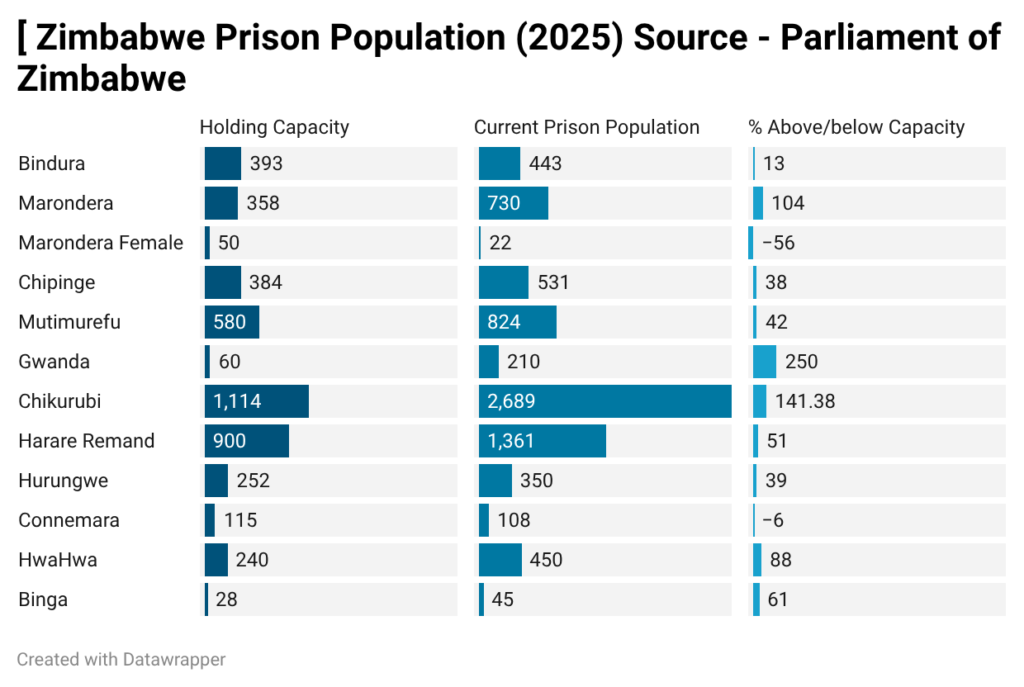
Mhlanga’s comments confirm the contents of a 2025 report by the Joint Portfolio Committee on Justice, Legal and Parliamentary Affairs and the Thematic Committee on Human Rights, which revealed that overcrowding in the country’s prisons remains one of the critical and persistent challenges affecting the Zimbabwe Prisons and Correctional Service (ZPCS), with some prisons holding more than 300% of their capacity.
The parliamentary report revealed that the majority of prisons were old and dilapidated having been built during the colonial era, for small populations. As a result, the bulk of Zimbabwe’s inmates are living in cramped and unsanitary conditions.
The report revealed that most of the country’s prisons are accommodating prisoners above their capacity, with Gwanda Prison carrying 350% of its capacity. In other words, Gwanda Prison was carrying 250% above its capacity.
Chikurubi Prison, on the other hand 2 689 prisoners despite having a capacity of 1 114, meaning it was 114% above capacity or 214% full while Harare Remand Prison had 1 361 inmates instead of 900, meaning it had 50% more than its holding capacity as seen in the visualisation below.
Mhlanga also bemoaned the fact that Harare Remand Prison does not have blankets. Inmates are allowed to bring a maximum of two blankets, one for putting on the floor and the other one for covering themselves.
“Some people have no blankets at all. They just sleep on the concrete floor,” he said.
“You can’t even help, because the prison has a no sharing of blankets policy in an effort to prevent sexual abuse. So, no two men can sleep in the same blankets.”
That’s not all. There is also a problem of lice which aggravates the hardship for inmates.
“Prison itself does not even have resources to deal with the problem of lice…ZPCS is supposed to spray the cells so that the problem of lice is dealt with, but they don’t even have the capacity; they don’t even have the resources to spray. But what makes the lice problem manifest is that the blankets that are in prison are never washed,” he said.
“This is because there is a problem of water at Harare Remand Prison, that’s number one. Number two, because inmates are allowed just two blankets or one blanket, it becomes impossible for them to wash the blankets and get enough time for them to dry and be ready for use in the evening. So, it basically means people are sleeping in blankets that have been used over and over again without any washing taking place.”
He said khakhi prison garbs are also passed from one inmate to another, without being washed.
“You don’t select which khaki uniforms you are given. They are just handed out from a bag. You wear that khaki uniform for as long as you are in Harare Remand Prison. When you leave, you just take them off and they’re put into the bag without being washed. No one is washing them, and when the next batch of prisoners come, they take that same khaki uniform that has been worn by someone for the past six months or four months without being washed, and they give it to the next inmate,” he said.
In separate interviews, the chair of parliament’s Portfolio Committee on Justice, Legal and Parliamentary Affairs Edson Zvobgo (Jnr) and Wilbert Mandinde, the acting director of Zimbabwe Human Rights NGO Forum said decongesting Zimbabwe’s prisons should get budgetary priority to preserve human rights and the dignity of inmates.
Zvobgo said nothing had changed since his committee presented an adverse report on the state of the country’s prisons last year.
“The reality is that we still have filthy and overcrowded prisons and this is largely because of budgetary and financial constraints. It’s unfortunate that when budget allocations are made, prisons are not the first thing that are considered,” Zvobgo said.
“We will fight for more resources to be allocated to the Ministry of Justice so that the conditions in the prisons are improved. Prison should be about rehabilitating inmates, and this cannot be done in filthy and overcrowded conditions which expose people to diseases.”
The parliamentary report says overcrowding had resulted in serious human rights violations and health implications. In many prisons, inmates are sleeping in cramped, poorly ventilated and leaking cells with strained sanitation systems and insufficient bedding resulting in increased risk of disease transmission.
The committees noted that open prisons like Connemara and Marondera Female Open Prison offer slightly better conditions due to lower populations and progressive models but highlighted that “these facilities represent exceptions rather than the norm”.
Mandinde bemoaned the fact that most of the country’s prisons were old and dilapidated, having been built during the colonial era. This was also highlighted in the parliamentary report, which revealed that the majority are over 100 years old and were poorly maintained.
Gwanda, Marondera and Harare Remand prisons, for instance, were built in 1910 while Binga Prison was constructed in 1920 and Connemara in 1924.
“Post independence in 1980, we have not seen enough investment in prisons. The government needs to act on the issue and also ensure that pre-trial detention is minimised. Bail should be given to deserving cases and none-custodial sentences such as community services should be considered. In some cases, fines should also be reduced to ensure that the prisons are depopulated,” Mandinde said.
Zvobgo also said Zimbabwe should also consider private prisons as was happening in South Africa. He said pre-trial detention should be minimised with suspects being presumed innocent until proven guilty.
He said there was need for more funding to the Ministry of Justice to ensure that the country had enough prosecutors and magistrates so that cases are expediated. He said the high turnover of prosecutors and magistrates, was contributing to prolonged pre-trial detention cases leading to crowding in prisons.
Mhlanga, for example, was kept in pre-trial detention for 72 days, but some inmates have endured worse.
A 2018 study titled Rights Behind Bars: A Study of Prison Conditions in Zimbabwe found numerous cases of pro longed pre-trial detention, with some people being in remand prison for more than 10 years.
For example, an inmate who was arrested in 2007 was found in custody in 2018 with his case at a standstill because one of the two State witnesses in the case had passed away while the other could not be located.
“The accused person had neither a remand date nor a trial date. The accused did not know what to do with his case given the circumstances,” the report said.
The second case involved Lameck Akim, a prisoner who had been in remand for more than seven years, since March 2010. He applied for bail in October 2016 but was instead given a trial date for November 2016. His matter was then remanded to 7 February 2017, but he failed to attend because of fuel challenges at prisons.
“He does not know what happened to his case since he failed to appear on the 7th of February 2017,” the report said.
Justice, Legal and Parliamentary Affairs secretary Vimbai Nyemba on Thursday said the judiciary was implementing measures to expedite cases involving remand inmates awaiting trial to ease overcrowding. She made the comments while touring Victoria Falls Prison, where she engaged inmates and inspected operations at the facility.
She addressed inmates’ concerns on overcrowding.
“We are working tirelessly with the courts to ensure that the cases of unconvicted inmates are expedited. It is our priority to streamline these processes, and I can assure you that during my next visit, we will see a clear and visible decrease in these numbers,” she said.
Nyemba said the interventions were aimed at reducing the remand population and improving case management within the justice system.