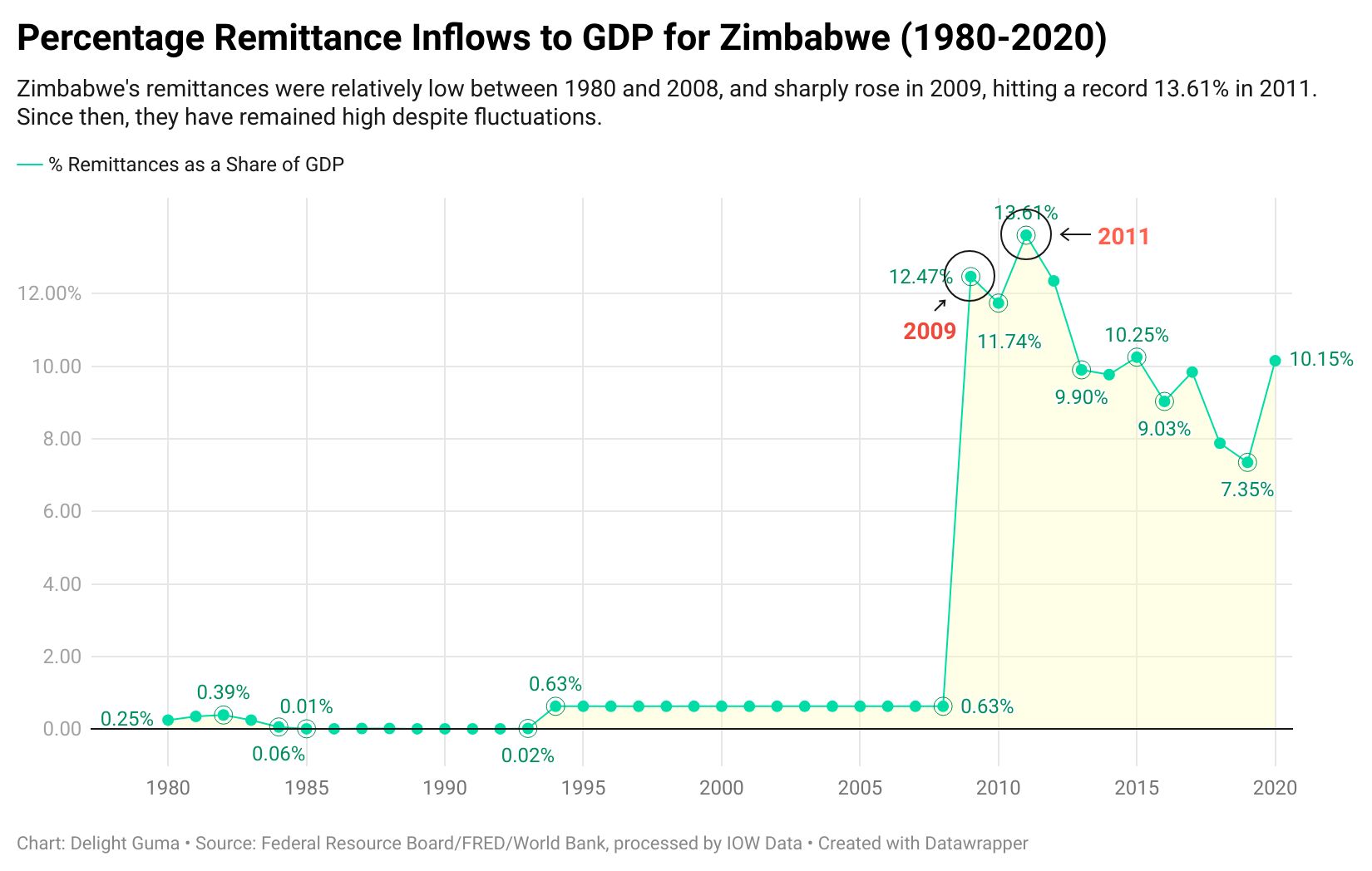
ZIMBABWE has witnessed an increase in remittances between 2009 and 2020, during the time when the country was going through some serious politically induced economic shocks, data analysed by IOW Data has shown.
Diaspora remittances, are financial transfers sent by individuals living and working abroad back to their home countries.
An increase in remittances in developing countries usually suggests that more people are leaving, often due to economic crises, political instability and or better prospects abroad, such as higher wages and better employment opportunities.
The data shows that while there was a consistently low trend of remittances as a share of the GDP between 1980 and 2008, averaging 0.39%, which sharply rose to 12.47% in 2009, hitting a record 13.61% in 2011.
After 2008, several people emigrated in search of greener pastures, after a serious economic meltdown which saw the country being engulfed in hyperinflation.
In this period, monthly inflation climbed to 79.6bn per cent, while the annual rate of increase surged to 89.7 sextillion per cent in mid-November 2008.
To help plug immigration, it is crucial for the government to address the root causes of immigration. This includes rolling out economic reforms, which include stabilising the currency and curbing inflation.