
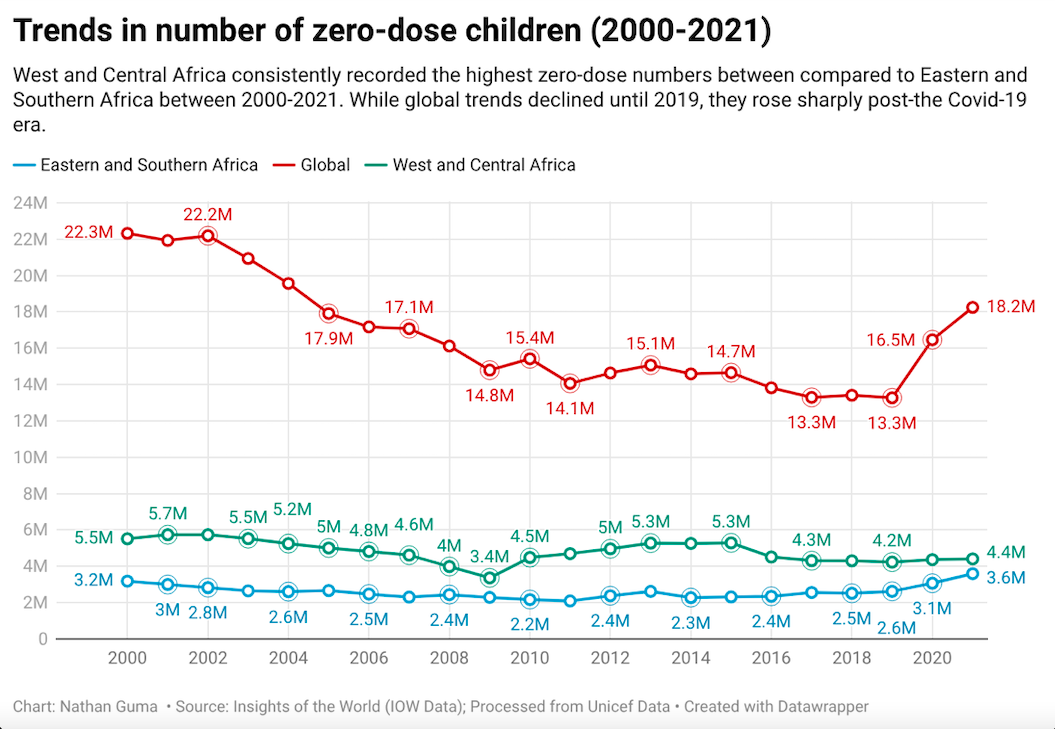
GLOBAL progress in reaching zero-dose children, those who have not received a first dose of a DTP-containing vaccine, improved steadily for nearly two decades before reversing sharply during the Covid-19 pandemic.
This highlights the impact of emergencies on health systems.
Data shows that in 2000, there were about 22.3 million zero-dose children worldwide, a number that declined unevenly but consistently over time, falling to around 14–15 million through much of the 2010s.
By 2019, the figure had dropped further to approximately 13.3 million, marking one of the lowest points in two decades and signalling a gradual expansion of routine immunisation systems.
That progress was short-lived following the Covid-19 pandemic.
In 2020, the number rose sharply to about 16.5 million, before climbing again to 18.2 million in 2021.
This represents an increase of roughly five million children compared to 2019 levels, effectively reversing years of gains in a short period.
The timing points directly to pandemic-related disruptions, including lockdowns, reduced access to health facilities, and interruptions in outreach services.
Zero-dose children
According to UNICEF, globally, one in seven children is zero-dose, meaning they have not received the first dose of the diphtheria, tetanus and pertussis (DTP)-containing vaccine.
This equates to 18.2 million zero-dose children who are vulnerable to a range of vaccine-preventable diseases.
The Covid-19 pandemic saw the number of zero-dose children increase by two million since 2020 and five million since 2019, reversing years of progress.
Regional comparisons
Regional patterns show persistent inequality.
West and Central Africa carry the largest burden throughout the period, starting at about 5.5 million in 2000 and remaining above 4 million even at its lowest points.
The region’s decline has been slow, and the post-2019 increase reinforces how fragile access remains.
Eastern and Southern Africa recorded lower figures overall, starting at around 3.2 million in 2000 and fluctuating between roughly 2.3 million and 3.5 million over time.
While the region shows moderate improvement, it also experienced a clear increase after 2019, rising to about 3.6 million in 2021.
Taken together, the data show that zero-dose children are not evenly distributed, and progress is not guaranteed. – IOW Data.

