TRENDS from international data sources have revealed that the majority of Zimbabweans have struggled to access electricity over the past decades.
Electricity is crucial for poverty alleviation, economic growth, and improved living standards.
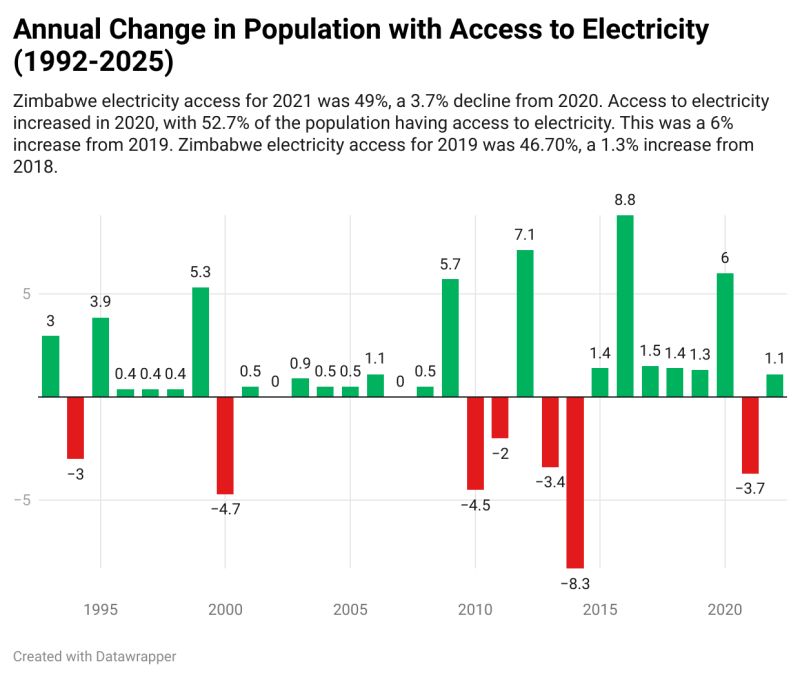
Data from Microtrends, accessed via The World Bank, shows that since 1992, the percentage of the population with access to electricity has largely remained between 28% and 50%.
Access to electricity is a key indicator of a nation’s development, affecting multiple aspects of life and economic progress. It is also recognised as essential for achieving many of the United Nations Sustainable Development Goals (SDGs).
However, unlike water and food [Section 77(a)(b) of the Zimbabwean constitution], access to electricity is not explicitly recognised as a human right.
Nevertheless, it remains a critical right, particularly as Zimbabwe strives to become an industrially and digitally developed nation.
According to the International Energy Agency (IEA) ‘access to electricity’ involves more than just electricity delivery to a household.
It also includes a requirement for households to consume a certain minimum amount of electricity, which differs based on whether the household is in a rural or urban area, and this threshold increases over time.