The Algorithmic Watch
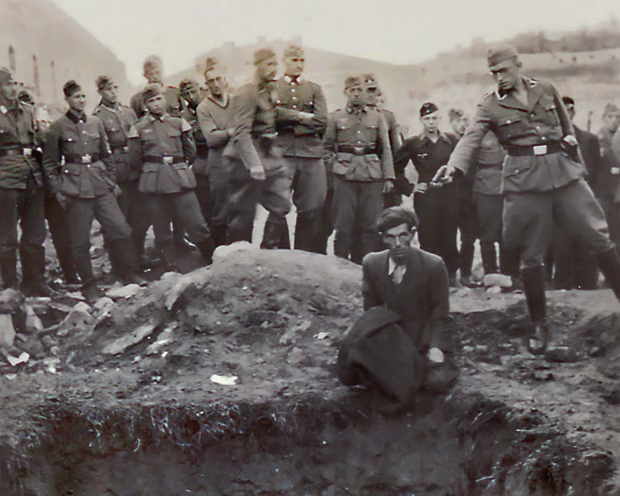
IT is one of the most chilling images of the Holocaust: a bespectacled Nazi soldier aims a pistol at the head of a kneeling man before a pit filled with corpses, surrounded by German troops.
Long known, mistakenly, as The Last Jew in Vinnitsa, the photograph has for decades been shrouded in mystery.
Now, the US-based German historian Jürgen Matthäus believes he has identified the killer, using a combination of traditional research and artificial intelligence.
According to findings published in the journal Zeitschrift für Geschichtswissenschaft (Journal of Historical Studies), the SS carried out the massacre on 28 July 1941, most likely in the early afternoon, in the citadel of Berdychiv, 150 kilometres south-west of Kyiv.
The killings were conducted by Einsatzgruppe C, one of several mobile units deployed in the newly occupied Soviet Union.
Matthäus said the discovery was an “incremental process” involving “traditional digging in dusty archives, lucky breaks, input from peers and the trailblazing involvement of volunteers from open-source journalism group Bellingcat.”
The suspected gunman, Jakobus Onnen, was born in 1906 in the German village of Tichelwarf, near the Dutch border. A French, English and gym teacher, he had joined the Nazi party before Hitler came to power in 1933.
A breakthrough came when a reader contacted Matthäus, saying he believed the gunman could be his wife’s uncle.
Although the family had destroyed letters from the eastern front in the 1990s, photographs survived. These were used by Bellingcat’s volunteers for AI image analysis.
“The match, from everything I hear from the technical experts, is unusually high in terms of the percentage the algorithm throws out there,” Matthäus said.
He added that “the AI experts tell me that this being a historical photo makes it more difficult to arrive at a 98 or 99.9% [match]” as often yielded in contemporary forensic work.
“Digital tools in the humanities have massively increased in use, but it’s usually for the processing of mass data, not so much for qualitative analysis,” Matthäus said. “This is clearly not the silver bullet – this is one tool among many. The human factor remains key.”
Of the 20,000 Jews in Berdychiv, only 15 remained by early 1944. “I think this image should be just as important as the image of the gate in Auschwitz,” Matthäus said, “because it shows us the hands-on nature, the direct confrontation between killer and person to be killed.” – IOW Data from The Guardian.