A YEAR-long global campaign led by European Commission President Ursula von der Leyen and South African President Cyril Ramaphosa has secured €15.5 billion to expand renewable energy and electricity access across Africa.
The year-long initiative, undertaken in partnership with Global Citizen and supported by the International Energy Agency, aims to expand electricity access, stimulate sustainable industrial growth, and accelerate Africa’s transition from fossil fuels to cleaner, modern energy systems.
The effort is designed to attract more public and private funding for Africa’s energy systems, support wider electricity access for households, and encourage a shift towards cleaner industry across the continent.
Speaking during the just-ended G20 Summit hosted by South Africa, President Ursula von der Leyen announced the €15.5 billion investment to support Africa’s clean energy transition.
“We are turbocharging Africa’s clean-energy transition. Millions more people could gain access to electricity; real, life-changing power for families, for businesses, for entire communities,” she said.
“This investment is a surge of opportunity: thriving markets, new jobs, and reliable, clean energy that meets the needs of partners across the globe. President Ramaphosa and I both look forward to a clean-energy future for the continent. A future led by Africa, with strong support from its friend and partner, Europe.”
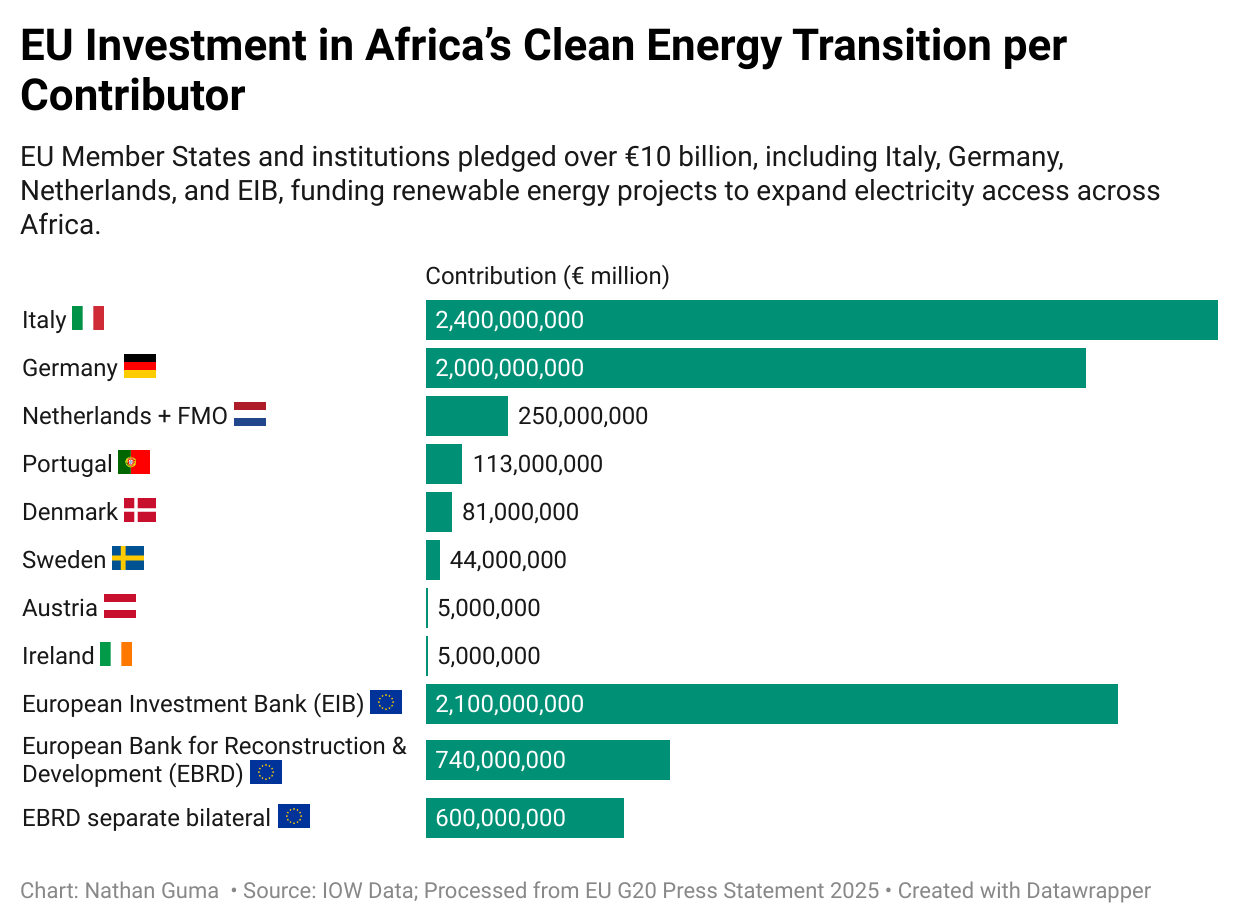
President von der Leyen pledged over €10 billion on behalf of Team Europe, with the remainder coming from EU Member States, European financial institutions, Development Finance Institutions, and estimated private finance.
Around 600 million people of the continent still lack reliable electricity, nearly half of the population, and more than 80% of the global electricity access gap, according to the United Nations Sustainable Development Goals Group (UNSDG).
While countries in Northern Africa, as well as Ghana, Gabon, and South Africa, have made progress in tackling the issue, challenges remain in Central Africa and the Sahel regions.
EU’s energy transition commitment
Team Europe’s package includes projects under the Global Gateway strategy, which includes commitments from Germany, France, Denmark, Italy, the Netherlands, and Spain.
The European Investment Bank pledged €2.1 billion, and the European Bank for Reconstruction and Development pledged €740 million.
EU Member States added bilateral finance worth more than €5 billion. Italy pledged €2.4 billion, Germany over €2 billion, the Netherlands and FMO €250 million, Portugal €113 million, Denmark €81 million, Sweden €44 million, and Austria and Ireland €5 million each.
The EBRD also made a separate bilateral commitment of more than €600 million.
Other institutions joined the pledging effort, with the African Development Bank committing to direct at least 20% of the African Development Fund’s seventeenth cycle to renewable energy.
Norway pledged around €53 million toward the fund for 2026 to 2028.
According to campaign figures, the pledges will support 26.8 gigawatts of new renewable energy generation and bring electricity access to 17.5 million households that currently rely on limited or no supply.
Of the €10 billion pledged by President von der Leyen, €3.1 billion had been announced at earlier engagements during 2025, including the EU-South Africa Summit, the Mattei Plan for Africa meeting, the Africa Climate Summit, the UN General Assembly, and the Global Gateway Forum.
The remaining €7 billion was announced in Johannesburg.
Several Team Europe bodies have also stated plans to raise renewable energy investments by 2030, amounting to an extra €4 billion.
The campaign began in November 2024 in Rio de Janeiro to secure commitments from governments, financiers, private companies, and philanthropies, and to support global targets agreed at COP28 to scale up renewable energy and improve energy efficiency.
Through the Global Gateway strategy and the Africa-Europe Green Energy Initiative, the EU is working with African governments and regional bodies on projects in power generation, transmission networks, and cross-border electricity trade.
These efforts form part of broader plans to support long-term energy growth across the continent. – IOW Data.