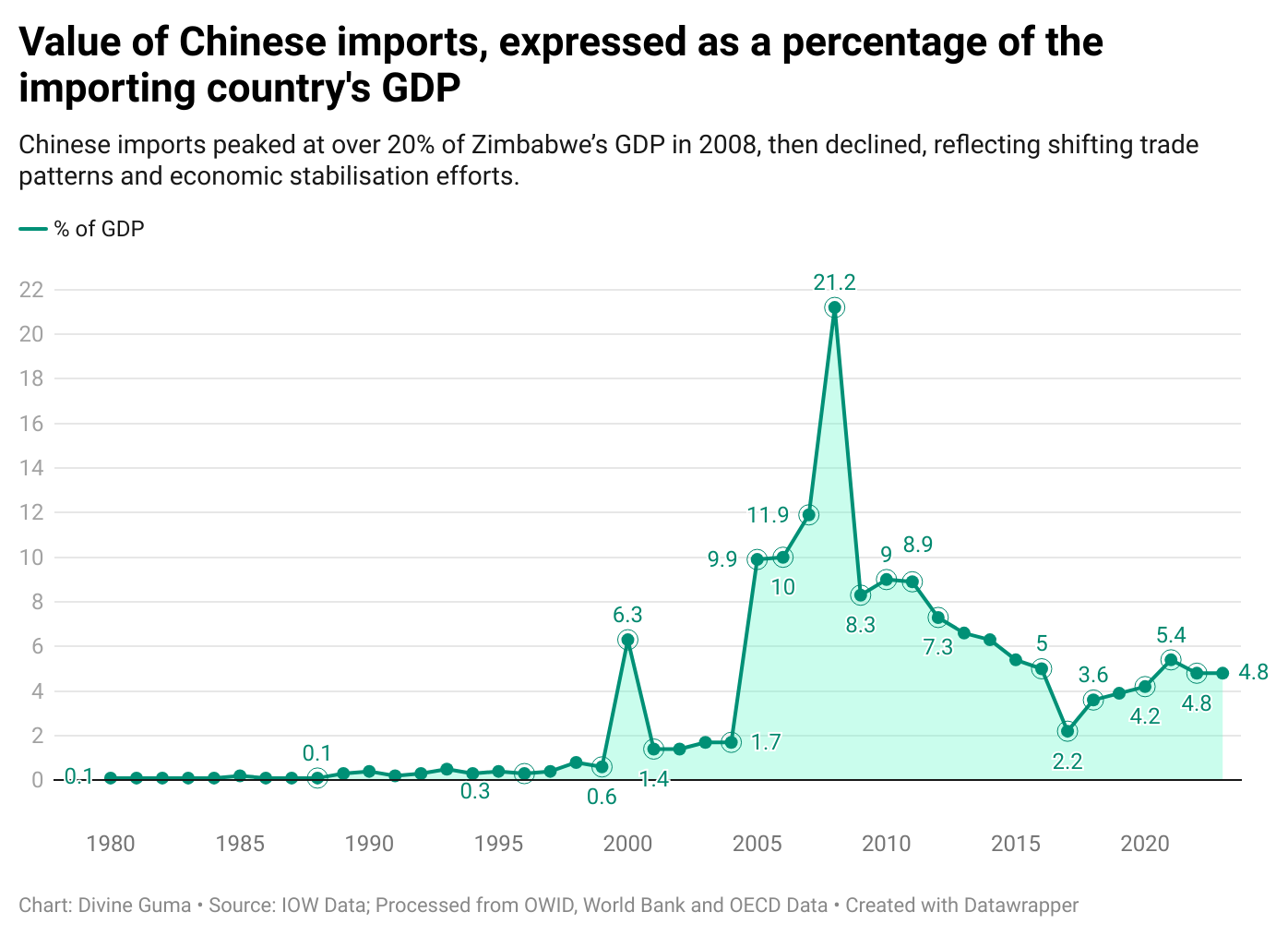
ZIMBABWE’S reliance on Chinese imports spiked dramatically during the 2000s, reaching more than 20% of GDP at its peak, before falling back to more moderate levels in recent years, according to data from the IMF and World Bank.
The data, which tracks Chinese merchandise imports as a share of the importing country’s GDP from 1980 to 2023, shows that Zimbabwe’s trade with China remained low throughout the late 1990s.
The country’s economic pivot toward Beijing accelerated after diplomatic isolation followed its fast-track land reform program in 2000.
Chinese imports surged from around 1% of GDP in the early 2000s to over 20% by 2008 – the highest level recorded, according to the data.
The spike coincided with Zimbabwe’s economic collapse, driven by hyperinflation and a severe contraction in GDP, which made imports a larger share of the overall economy.
Following the 2009 dollarisation and stabilisation efforts, China’s share of imports began to decline, falling below 10% by 2013 and stabilising around 4-6% in the past five years.
While Zimbabwe continues to rely on Chinese goods – particularly in construction, mining equipment, and electronics – the country has gradually diversified its trade portfolio.
Zimbabwe’s case also illustrates how GDP contractions can distort import ratios, making them appear disproportionately high. – IOW Data.