NEW data has shown that Zimbabwe’s scientific publishing output has fluctuated significantly over the past two decades, which, however, falls behind regional neighbours.
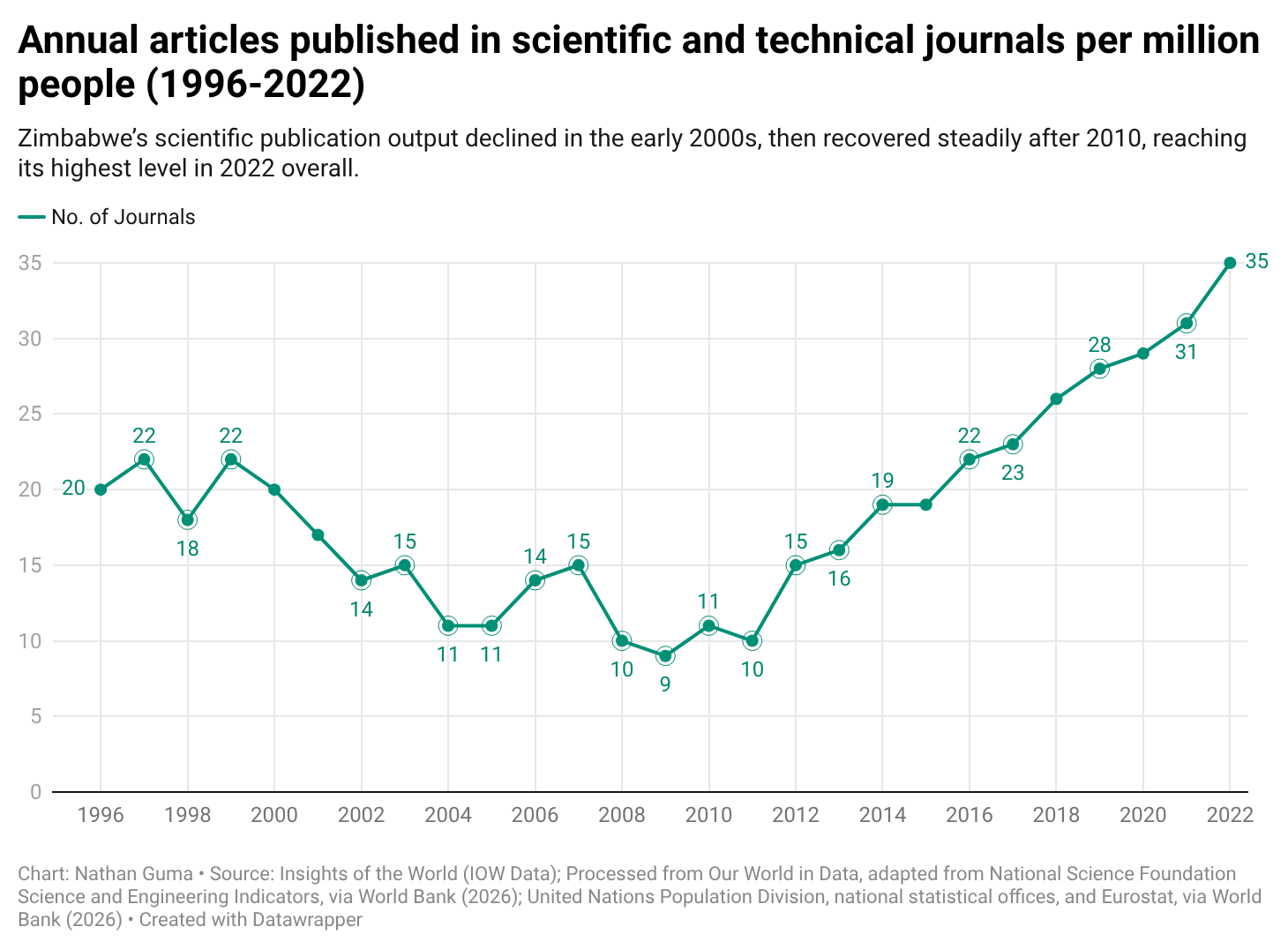
In the late 1990s, Zimbabwe produced about 20 to 22 scientific articles per million people annually.
This output declined steadily in the early 2000s, falling to nearly 10 articles per million people by around 2008.
The period between 2009 and 2013 shows uneven recovery, with output fluctuating between approximately 10 and 15 articles per million people.
From 2014 onwards, Zimbabwe’s scientific publishing output began a sustained and consistent increase across all measured years.
By 2016, output had risen above 20 articles per million people, marking a return to levels last seen in the late 1990s.
The upward trend accelerated after 2017, with annual output increasing steadily and surpassing 25 articles per million people.
By 2020, Zimbabwe’s output reached close to 30 articles per million people, reflecting continued growth in research activity.
The data shows a peak of about 35 articles per million people in 2022, the highest level recorded in the dataset.
Comparison with other countries
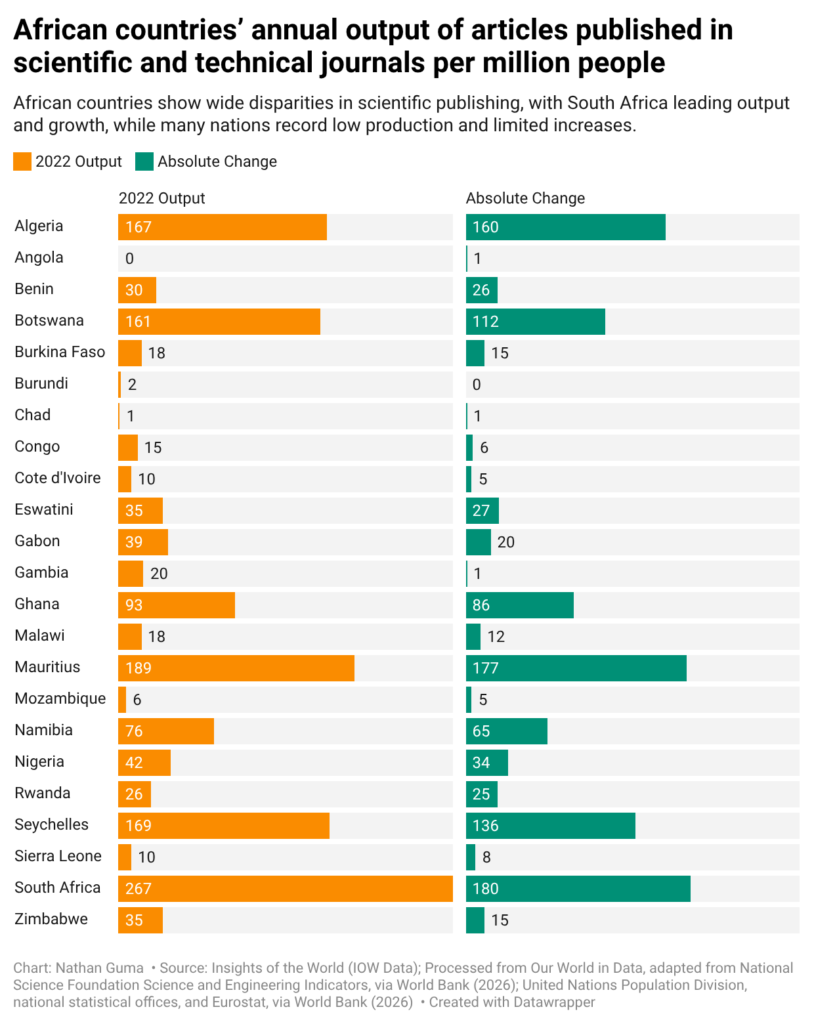
While Zimbabwe’s scientific publishing output has an absolute change of 15, it is lower than the world average of 249.
It also ranks lower than neighbours, South Africa and Botswana, among others, showing a need for improvement.
South Africa leads with the highest output at 267 articles per million people, followed by Mauritius (189), Seychelles (169), Algeria (167), and Botswana (161).
Mid-level performers include Ghana (93), Namibia (76), and Nigeria (42), showing moderate research output.
The lowest outputs are recorded in Chad (1) and Angola (0), indicating minimal scientific publishing activity.
In terms of growth, South Africa shows the largest absolute increase (180), followed by Mauritius (177), Algeria (160), and Seychelles (136).
Overall, the data shows a wide disparity in scientific output across African countries, with a few leading nations driving most of the growth.
In developed countries, the United Kingdom and the US had some of the highest outputs of 1,369 and 1,562, respectively, in 2022.
Overall, the trend reflects a long-term recovery and expansion in Zimbabwe’s scientific research output following earlier declines in the 2000s, with output expected to improve over time. – IOW Data.